
History of Warhammer / first edition
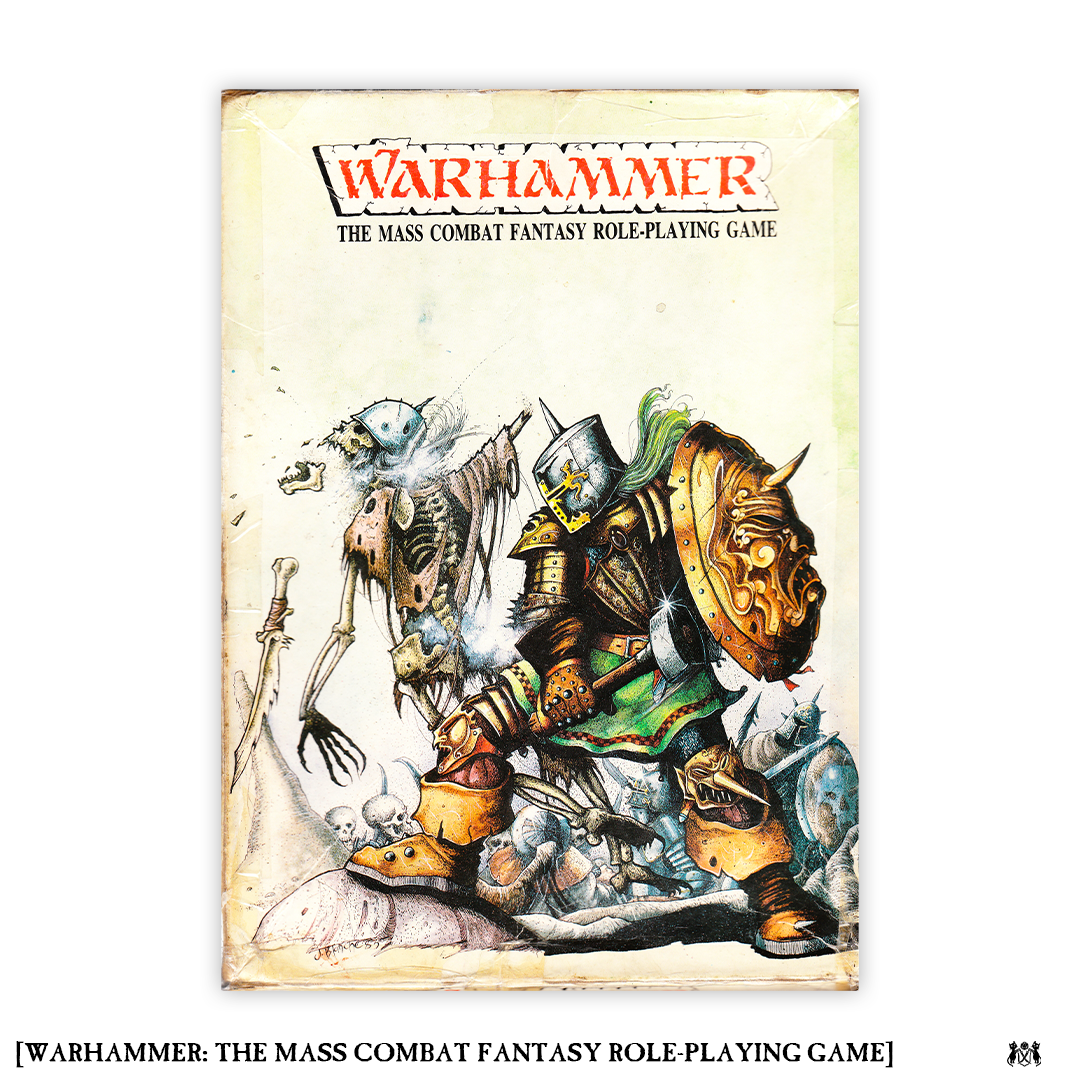
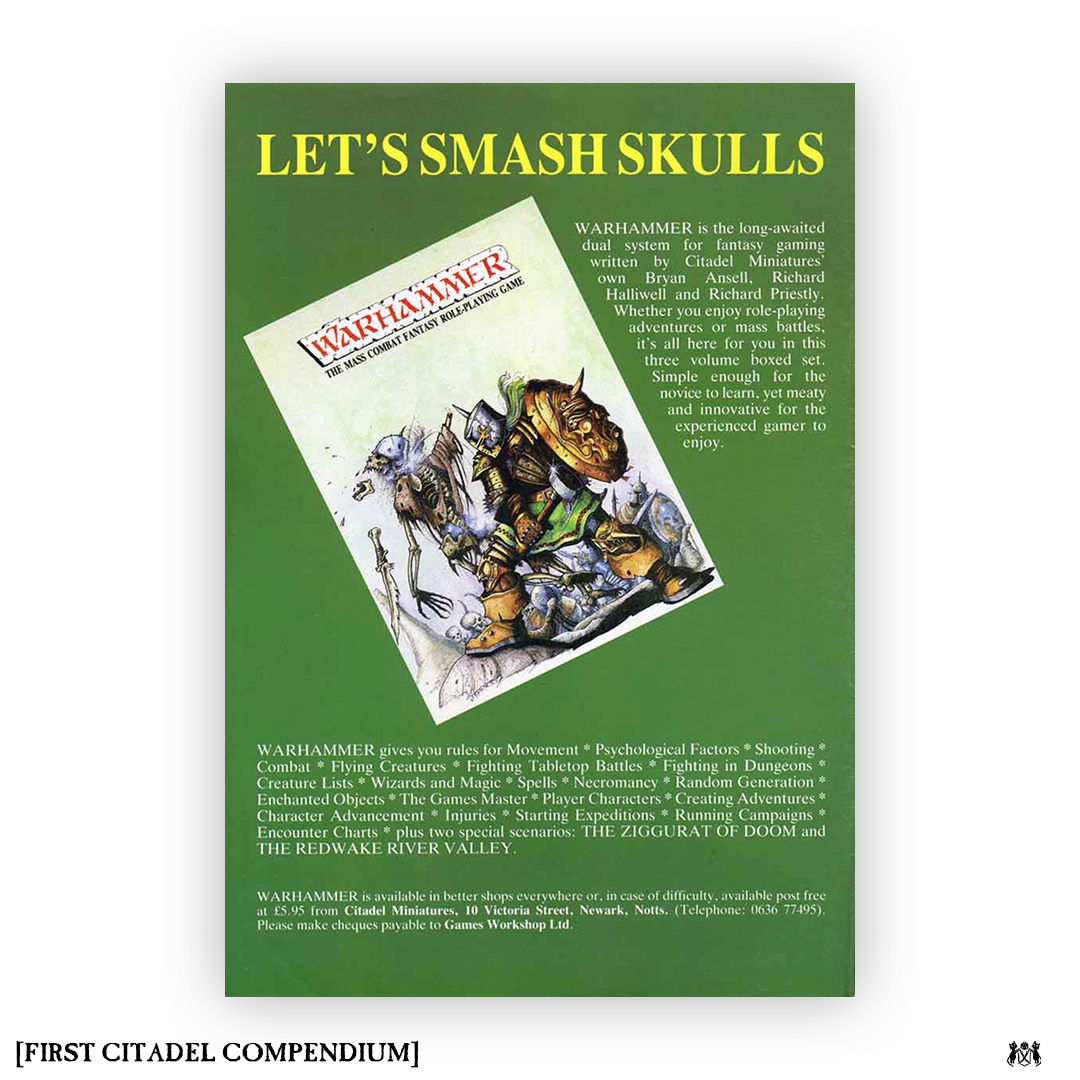
The first edition of Warhammer was a deceptively simple affair: a boxed set with a dramatic skeleton-smashing warrior emblazoned upon it that contained three booklets of typed rules with which players could run an underwhelming roleplaying game or a thrilling fantasy wargame. Drawing on the success of Dungeons & Dragons, the fantasy worlds of Tolkien, folklore, and mythology, and the tried & true mechanics of historical wargaming the fledgling product from the Citadel Miniatures team at Games Workshop laid the foundation for spectacular legacy that would change not just the gaming table, but the entire world.
Warhammer was first published in 1983 as a way to encourage roleplaying game fans to buy more fantasy models. Citadel Miniatures, the publishers of the game, was a joint venture between Steve Jackson & Sir Ian Livingstone - the founders of Games Workshop - and Bryan Ansell, a visionary businessman who had previously helped to establish Asgard Miniatures in Nottingham. Ansell had approached the Games Workshop managing directors in 1978 with a plan to create a new company that could provide an exclusive miniatures range for their hobby retail stores.
The game was conceived by Ansell as a brief set of rules that could be given away for free on a single sheet of paper. The American roleplaying game Dungeons & Dragons, first imported into the UK by the fledgling Games Workshop in 1975, had revolutionised the gaming market and created a generation of gamers. Initially, Citadel focused on producing fantasy miniatures that could be used in games of D&D and others like it, but Ansell was convinced that there was money to be made by convincing RPG gamers to buy not just a handful of minis for a single dungeon, but rather to create glorious armies of miniatures that could all be used in the same game at the same time.
Richard Halliwell and Rick Priestley were childhood friends, having grown up playing historical wargames at clubs like the Lincoln Model Railway and Wargames Society. Together they designed the fantasy miniatures game Reaper and the science fiction skirmish game Combat 3000, both of which were published by Nottingham based games company Tabletop Games in 1978 and ‘79 respectively. Bryan Ansell had also worked with Tabletop Games, publishing his own sci-fi game Laserburn with them in 1980. Seeing promise in the duo's work Ansell hired Halliwell and Priestley at Citadel and tasked them with creating game rules for use with the company’s fantasy miniatures.
Halliwell and Priestley, working to Ansell’s brief, created a ruleset that went beyond a simple single sheet game and all three were credited with the text for the final game. Published under the name Warhammer: The Mass Combat Fantasy Role-Playing Game it was sold as a boxed set with the rules split into three slim volumes: Tabletop Battles, Magic, and Characters. Art for the cover of the box was provided by John Blanche, who has also created the cover illustration for Games Workshop’s 1977 reprint of Dungeons & Dragons that was sold to the UK and European market. Blanche’s Warhammer cover featured a smashingly brutal warrior that would quickly be available in Citadel’s Warriors of Chaos Specialty Set with the name Uthmog Elvenbane. In time the character would be nicknamed Harry the Hammer and would go on to appear in many different guises over the years.
Warhammer’s Internal illustrations were provided by Tony Ackland, an artist who had worked with Bryan Ansell at his former miniatures company Asgard. Imagery of heroic knights and fantasy monsters generously littered each booklet and there are some designs that would become common features of the series: horn helmed wights, sinister sorcerers, and spike-armoured warriors all feature on the covers and pages of the books.
The rules for the game followed the developing tradition of historical wargaming led by designers such as Donald Featherstone. Several ideas were incorporated into the game similar to those that regularly appeared in Featherstone’s work such as I-Go-U-Go turn order where only the active player may move and shoot with their forces and the concept of a saving throw when struck by an enemy blow. Each creature, from human to giant, was provided with a set of characteristics: Move, Weapon Skill, Ballistic Skill, Toughness, Wounds, Initiative, Attacks. Although the specifics of how some of these characteristics functioned would go on to change in later editions they would all remain relevant to the game for its entire 40 year history.
There was no comprehensive setting for the game included in the Warhammer box, instead it drew on a wide variety of fantasy tropes and folk lore, with particular inspiration from key texts such as J.R.R. Tolkien’s The Lord of the Rings and Gygax & Arneson’s Dungeons & Dragons. Key to the design brief was the idea that players should be able to make use of their entire existing miniatures collection, so the game was populated with Dwarves, Elves, Orcs, and the undead, and many more typical fantasy creatures that could already be found in the Citadel miniature range. Both Citadel’s miniatures and those from Ral Partha (produced under licence by Citadel in the UK) were recommended throughout the text.
Two scenarios could be found in Warhammer: The Ziggurat of Doom and The Redwake River Valley. The former offered a simple skirmish battle between a small band of Dwarves and a horde of goblins. Redwake was designed as an introductory adventure that made use of the RPG elements included in the game’s rules. Players could create characters with unique characteristics and equipment, magical items and spells, and there were also rules for advancing these characters with experience as they achieved more in battle. These roleplay rules, though mentioned in the formal title of the game - Warhammer: The Mass Combat Fantasy Role-Playing Game - were included in an effort to align with the massively successful D&D. However, most reviews, whilst finding the mass combat rules to be worthwhile, did not look favourably on the underwhelming roleplaying rules. Perhaps unsurprisingly, the pure roleplaying rules would increasingly be excised from later editions of the battle game and used as the basis for a dedicated Warhammer Fantasy Roleplay game instead.
Over time Citadel released special boxed sets that included full units led by named characters. These Regiments of Renown, with names such as Bugman’s Dwarf Rangers and Grom’s Goblin Guard, also included background information detailing the exploits of their infamous heroes and villains. Each regiment added to an emerging sense of a shared Warhammer world in which games could be set. Several boxed sets, such as the Champions of Chaos and Warriors of Chaos also included scenarios printed on folded A4 sheets that told stories of a slowly encroaching magical Chaos force that was tainting and destroying the world. The idea of Chaos as an eldritch and unknowable evil power was one that fascinated Bryan Ansell, an avid reader of Michael Moorcock fiction. Moorcock’s work such as The History of the Runestaff and Elric of Melniboné, featured rival gods of Chaos and Law and a balance between them that was maintained by an Eternal Champion reborn in different guises on different worlds. This Moorcockian mythology would become a major influence for the creation of Chaos in Warhammer, a project that Ansell started soon after the game’s release with the promise of a Realms of Chaos sourcebook. It would be many years, and two more editions, before that project would be completed, but the touch of Chaos was fully incorporated into Warhammer’s world long before then.
Within a year the second edition of Warhammer was published. Again written by Halliwell, Priestley, and Ansell it only improved on the fundamentals of the original and helped to drive the exponential growth of Citadel and Games Workshop. The publication of Warhammer in 1983 marked an inflection point in the history of Games Workshop. Over the next few years circumstance and success would see Bryan Ansell take over management of the company leading to a pivot towards miniatures and games developed by the Citadel team. The surging popularity of Warhammer not only made the logic of such a decision understandable, but irrefutable. Games Workshop began an inexorable move away from being a gaming importer in the general tabletop business to being a miniatures manufacturer solely focused on the Warhammer business.
Further Reading: